Bikepacking food
I’m building a collection of campsite recipes and three slightly different day menus for bikepacking. My planning target is 5,000 kcal per day, or 15,000 kcal for a three-day trip.
The idea is to share enough ingredients to keep packing simple, while varying flavours, textures and meals so I still want to eat them on day three. Breakfast stays the same: overnight oats are low effort, with the preparation done on arrival at camp for the following morning. Lunches, dinners and other snacks will provide the variety.
Recipes
| Recipe | Packed food weight per serving | Energy per serving |
|---|---|---|
| Campsite overnight oats | 320 g dry | About 1,261 kcal |
| Jus’ Sugs | 60 g carbohydrate mix | About 240 kcal |
| Vegetables with rice and quinoa | 240 g cooked grains + 30 g dried veg | About 540 kcal |
Food Calories are recorded as kcal. Food weights exclude packaging, and dry weights exclude added water. A ready-cooked grain pouch includes its water. Energy estimates use the ingredient values listed with each recipe, so they can be adjusted for different products.
Three day menus
These are menus in progress. Every day includes one serving of overnight oats, two Veloforte bars, one pack of Veloforte energy chews, one Veloforte energy gel, two cheese strings, 120 g of Jus’ Sugs as two 60 g servings, one handful of savoury trail mix, two handfuls of chocolate-and-nut trail mix and one US quart of Drinking milk. Day 2 also includes one packet of Jell-O instant pudding.
Days 1 and 3 each have one flavoured tuna packet shared between two wraps. Day 2 has peanut butter shared between two wraps. The provisional peanut butter portion below is one 32 g serving from a squeeze pack.
Dinner on every day is one rice-and-quinoa pouch with rehydrated vegetables, using 30 g dried vegetables per meal as a planning portion.
Swipe or scroll sideways to see all columns.
The kcal column is the approximate energy for the quantity shown on a day when that food is included. Trail mix uses 30 g per handful: one savoury and two chocolate-and-nut handfuls per day. Pudding is counted as dry mix only.
Daily energy (kcal)
| Day 1 | Day 2 | Day 3 | |
|---|---|---|---|
| Accounted for | 4,676 | 5,146 | 4,676 |
| Below target | 324 | 0 | 324 |
| Above target | 0 | 146 | 0 |
| Daily target | 5,000 | 5,000 | 5,000 |
Days 1 and 3 have about 324 kcal left to allocate; Day 2 is already about 146 kcal above the target. The Day 2 total excludes milk for the pudding; count that when its quantity is set, then balance portions across the menus.
Veloforte planning values
Flavours and pack sizes differ. These ranges come from the manufacturer values checked on 6 October 2026; the averages give each listed flavour/size equal weight and are rounded to whole kcal before use in the menus.
| Item | Serving used | kcal range | Average kcal |
|---|---|---|---|
| Energy bar | 1 × 55 g bar; 6 flavours | 221–255 | 233 |
| Energy chews | 1 × 50 g pack; 5 flavours | 167–179 | 172 |
| Energy gel | 1 whole gel; 7 options, 33–67 g | 89–182 | 107 |
| Daily Veloforte food | 2 bars + 1 chew pack + 1 gel | 698–871 | 745 |
The bar average covers Zenzero, Classico, Ciocco, Avanti, Di Bosco and Mocha; the chew average covers Fresco, Citro, Amaro, Nero and Mela. Gel values cover Tempo, Riba, Primo, Doppio, Desto, Rosso and Limon.
The gel range includes the larger Rosso (45 g) and Limon (67 g) packs. The five 33 g gels alone are about 89–90 kcal each. Bar calculations use the individual 55 g labels; a 62 g variety-pack table also exists. Ciocco’s per-bar and per-100 g figures do not consistently agree; these estimates use the published per-bar values. Use the actual wrapper values when packing.
Across those options, bars provide about 29–36 g carbohydrate, 4–8 g protein and 7–11 g fat each; chews provide 42–44 g carbohydrate per pack, with less than 0.5 g each of protein and fat. Gels provide 22–45 g carbohydrate, with less than 0.5 g each of protein and fat. The full daily Veloforte allocation averages about 137 g carbohydrate. Amaro chews and Doppio and Desto gels each contain 75 mg caffeine per pack.
The daily calculation is 2 × 233 + 172 + 107 = 745 kcal of Veloforte food. The overall daily totals above also include the oats, cheese strings, Jus’ Sugs, trail mixes, Drinking milk, that day’s wraps and dinner. Day 2 adds 360 kcal for the dry pudding packet.
Trail mix estimates
For packing, I estimate one small handful at 30 g. This rounds the Almond Board’s 28 g handful guide to an easy portion weight. Applying that nut portion to trail mix is a planning estimate: hand size and the mix’s ingredients affect the actual weight.
The calorie estimates use these reference products, checked on 7 October 2026, and are rounded to the nearest 10 kcal per daily portion:
| Mix | Daily portion | Reference label | kcal used |
|---|---|---|---|
| Savoury | 1 handful ≈ 30 g | Planters Spicy Nuts & Cajun Sticks: 160 kcal per 28 g | 170 |
| Chocolate and nut | 2 handfuls ≈ 60 g | Planters Nuts & Chocolate: 180 kcal per 33 g | 330 |
| Total | 3 handfuls ≈ 90 g | 500 |
The calculations are 30 × 160 ÷ 28 ≈ 171 kcal for the savoury mix and 60 × 180 ÷ 33 ≈ 327 kcal for the chocolate-and-nut mix. These products are references for the estimates, not fixed shopping choices. Use the label on the mix packed and weigh a handful once to adjust the portions if needed.
Cheese, pudding and drink estimates
The cheese estimate uses Frigo Cheese Heads String Cheese at 80 kcal and 6 g protein per stick: two give 160 kcal and 12 g protein. This is a reference product for the calculations; adjust for the cheese packed and follow its storage instructions.
The pudding estimate uses a 3.4 oz Jell-O vanilla instant pudding packet: four labelled servings at 90 kcal give 360 kcal for the whole dry packet, with 92 g carbohydrate. The packet calls for 2 cups of cold milk. Milk powder and water for preparation are additional to the dry packet, the breakfast ingredients and Drinking milk; their quantities and calories still need adding.
Jus’ Sugs supplies approximately 240 kcal per 60 g carbohydrate serving, or 480 kcal for the daily 120 g. Water and any separately added salt do not add calories.
Drinking milk
Every day includes one US quart (about 946 mL) of Drinking milk, made from approximately 126 g whole milk powder, supplying 630 kcal. This is a separate allocation from the powdered milk in the oats and any milk for pudding.
The reference is Hoosier Hill Farm Whole Milk Powder, checked on 7 October 2026. Its quart directions use 1 cup plus 2 tablespoons of powder (18 tablespoons) with about 3⅔ cups of water. The nutrition label gives 7 g and 35 kcal per tablespoon: 18 × 7 = 126 g and 18 × 35 = 630 kcal. The quart is the approximate finished drink volume. Other brands can need different quantities; follow the powder’s own mixing directions and label.
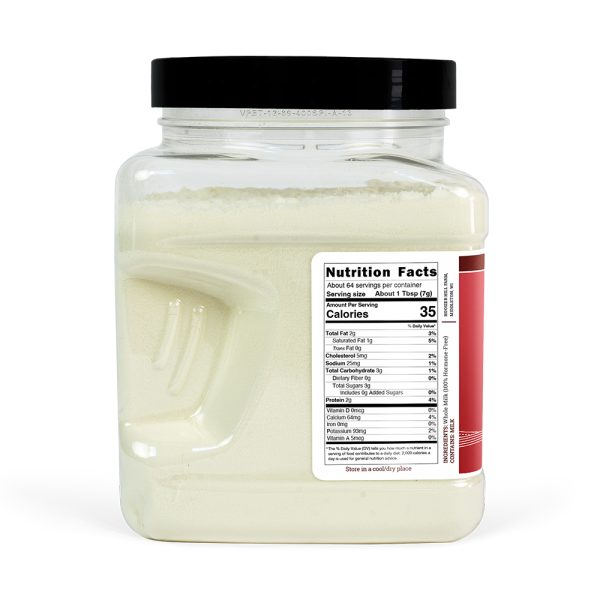
For drinking on the go, pack the powder dry and mix smaller portions when needed. This reference powder is not instant and mixes best with warm drinking water and thorough stirring; the maker recommends chilling overnight for the best texture. If carrying prepared Drinking milk, keep it at 4°C / 40°F or below. Otherwise, consume within 2 hours, or 1 hour above 32°C / 90°F, following the FDA’s outdoor food guidance.
Wrap estimates
Each day uses two 8-inch flour wraps. On Days 1 and 3, split one whole flavoured tuna packet between the two wraps. On Day 2, split 32 g peanut butter (about 2 tablespoons) from a squeeze pack between them. The following reference labels were checked on 7 October 2026:
- Mission Soft Taco Restaurant Style Flour Tortillas: 50 g and 140 kcal per wrap. Two wraps supply 280 kcal.
- StarKist Tuna Creations Lemon Pepper: one 74 g (2.6 oz) packet supplies 80 kcal and 16 g protein.
- SKIPPY Creamy Peanut Butter Squeeze Pack: 32 g supplies 190 kcal and 7 g protein.
That gives 360 kcal and 174 g of food for the two tuna wraps on each of Days 1 and 3, and 470 kcal and 132 g for the two peanut butter wraps on Day 2, excluding packaging. Divide the filling between the wraps and roll them up when ready to eat.
Tuna flavours can vary across the days; Lemon Pepper is the calorie reference, not a fixed flavour choice. Adjust for the actual packets and wrap sizes packed. The provisional peanut butter allocation is 32 g for Day 2 only. If carrying a larger tube, any uneaten surplus and packaging add carried weight but are excluded from the menu’s calories.
Vegetables with rice and quinoa
A simple dinner for each of the three days: one ready-cooked rice-and-quinoa pouch with 30 g dried mixed vegetables, rehydrated at camp. This planning portion supplies about 540 kcal and weighs 270 g before adding water, excluding packaging. The grains are already hydrated; only the vegetables are packed dry.
Reference products checked on 7 October 2026:
- Seeds of Change Quinoa & Brown Rice with Garlic: one whole 240 g pouch supplies 440 kcal. Use the whole-pouch value, not the smaller cup serving on the label.
- Harmony House dried vegetable mix: 30 g dry. Its nutrition sheet lists 330.76 kcal per 100 g dry: 30 × 330.76 ÷ 100 ≈ 99 kcal, rounded to 100 kcal for the menus. This is an unseasoned vegetable blend.
Bring a stove, fuel, cooking pot with lid and spoon. At camp:
- Put the vegetables in the pot with drinking water. The maker’s rehydration directions start with two volumes of water for one volume of dried vegetables; simmer for about 10–15 minutes, adding water if needed until tender.
- Open the grain pouch and empty it into the pot. Stir and heat thoroughly. The pouch’s stovetop directions use 2 tablespoons (about 30 mL) water; use remaining vegetable cooking water or add a little more as needed.
- Season to taste and eat the whole portion. Any added oil or sauce needs counting separately. Try the meal before the trip to settle the water, fuel and seasoning amounts.
The same base dinner is counted on all three days. Different seasonings or grain-pouch flavours can provide variety; adjust calories for the actual products packed.
Three-day quantities so far
| Item | Three-day quantity |
|---|---|
| Oats breakfast | 3 × 320 g dry servings: 750 g oats, 75 g powdered peanut butter, 135 g powdered milk |
| Veloforte bars | 6 bars |
| Veloforte energy chews | 3 packs |
| Veloforte energy gels | 3 gels |
| Cheese strings | 6 sticks |
| Jus’ Sugs | 6 × 60 g servings: 360 g carbohydrate mix (about 200 g maltodextrin and 160 g fructose) |
| Savoury trail mix | 3 handfuls, about 90 g |
| Chocolate-and-nut trail mix | 6 handfuls, about 180 g |
| Drinking milk | 3 × 126 g whole milk powder: 378 g, making about 3 US quarts (2.84 L) |
| Flour wraps | 6 × 50 g wraps: 300 g; 4 for tuna and 2 for peanut butter |
| Flavoured tuna packets | 2 × 74 g packets: 148 g, for Days 1 and 3 |
| Peanut butter squeeze pack | 1 × 32 g serving for Day 2 (provisional pack size) |
| Rice-and-quinoa pouches | 3 × 240 g ready-cooked pouches: 720 g |
| Dried mixed vegetables | 3 × 30 g portions: 90 g |
| Jell-O instant pudding | 1 packet for Day 2, plus preparation milk to account for |
This accounts for about 14,497 kcal of the 15,000 kcal three-day target, before adding the pudding milk. Totals use the unrounded oats calculation and the rounded Veloforte, trail mix and vegetable estimates; displayed day totals may differ by 1 kcal when summed because of rounding. The two trail mixes add about 270 g and 1,500 kcal across the trip. Pack the first breakfast for preparation the evening before the first riding day, then prepare each following breakfast at camp. Follow the oats preparation and cold-storage guidance.
Building the collection
For each recipe I’ll keep ingredient weights, calories per serving, water and equipment needs, preparation details, and feedback from trying it. Variations will have their own quantities and calorie totals.
Next steps are to establish the oats water quantity and container size, try the dinner, settle the peanut butter pack size, add the pudding milk and balance the day totals. I’ll then complete the three-day shopping and packing list, including total food weight, and record flavour variations.